

Ingredient reference photographed at our Makassar desk — a single capsule held beside the powder and oil forms the same nutrients arrive in.
A practical guide to men's supplement ingredients
Most men's vitamin formulas draw from the same short list of vitamins, minerals, and extracts. Learn that list and product labels stop looking like a foreign language.
Vitamins you'll see in nearly every formula
Vitamin C, vitamin D, and the B-complex form the backbone of most men's multis. Vitamin D appears frequently because dietary sources are limited and sun exposure varies through the year. The B-vitamins show up for their role in normal energy metabolism, which is why energy-positioned products often list them prominently near the top of the panel.
Amounts vary widely between segments. Life Extension Two-Per-Day lists higher quantities than mainstream options like Centrum Men — that gap is the main practical difference between the two approaches, not a difference in which vitamins appear at all.
Forms to look for on the panel: ascorbic acid and ascorbate salts for vitamin C, cholecalciferol for D3, and the individual B names — thiamin, riboflavin, niacin, B6, B12, folate.
Vitamins and minerals for men, read closely
Trace minerals in their dry forms, separated for comparison — zinc, magnesium, selenium and iodine.
Trace minerals and what they do
Zinc, magnesium, selenium, and iodine are the trace minerals you'll see most often in men's formulas. They appear in smaller amounts than the vitamins, and the listed form matters as much as the quantity. Some formulas use chelated versions, where the mineral is bound to an amino acid; others use simpler oxides and sulfates.
What the form tells you
- Chelated minerals such as zinc glycinate list a specific carrier on the panel.
- Oxides and sulfates are cheaper forms and appear more often in mainstream multis.
- A larger milligram number does not automatically mean a better-absorbed mineral.
Herbal extracts in men's blends
Saw palmetto, pygeum, green tea, maca, and astragalus are the extracts most frequently listed in formulas for men. Saw palmetto and pygeum appear in age-specific products, green tea and maca in energy-positioned ones, and astragalus in blends leaning toward traditional use.
Each extract has a stated reason for inclusion. Whether it belongs in your routine is a separate question — the point here is recognizing the name when it appears and understanding why a formulator reached for it.
Saw palmetto
Appears in age-specific formulas, usually as a standardized berry extract listed with a fatty acid percentage.
Pygeum
Commonly paired with saw palmetto in the same age-specific blends, derived from the bark of the African cherry tree.
Green tea extract
Found in energy-positioned products, usually standardized to EGCG and listed alongside the B-vitamins.
Maca root
A Peruvian root listed in energy and endurance formulas, usually as a plain root powder rather than a standardized extract.
Astragalus
Appears in blends leaning toward traditional use, often grouped with other roots rather than listed alone.
Whole-food positioning
Whole-food versus synthetic forms
Some products, including Codeage Men's Daily Multivitamin, take a whole-foods style positioning, where nutrients are described as coming from food sources. Others use standard synthetic forms that are produced directly.
Both approaches list the same nutrients on the panel; the sourcing language and the price differ. Neither approach is inherently better for everyone — read what the panel actually says, and treat the front-of-label story as a claim to check rather than a fact.
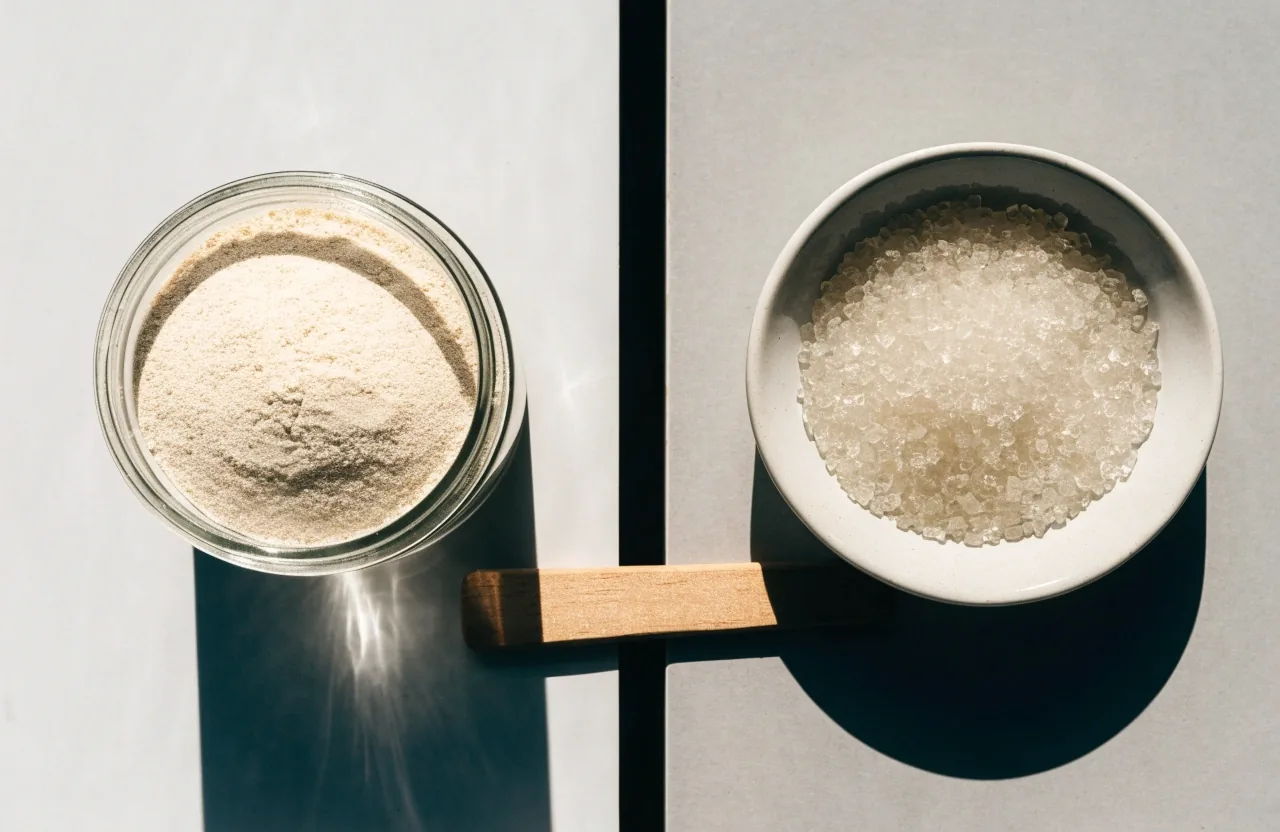
Two sourcing styles side by side: a food-style powder and standard crystalline nutrients.
What actually changes between them
Tablet size, capsule count per serving, and cost per day move more than the nutrient list does. Those three are worth comparing before the sourcing story.
Compare these ingredients across formulasWhat "high-potency" means in practice
High-potency usually means larger listed amounts of the same nutrients, not different ingredients. Solgar VM-75 and Life Extension Two-Per-Day sit in this segment. The trade-off is often a larger tablet or more capsules per serving, which matters if you already dislike swallowing several at once.
If you're comparing a high-potency product against a standard one, look at cost per day rather than cost per bottle. A bigger bottle at a higher price can still work out cheaper per serving, and the reverse is just as common.
Two products can list the same twelve nutrients and still cost very different amounts per day. The serving count on the panel is what settles it.
Reading a proprietary blend
When a label lists a blend with one total weight instead of individual amounts, you can tell which ingredients are present but not how much of each one. That's not automatically a red flag — some traditional combinations are grouped this way on purpose — but it does limit comparison.
Products with fully disclosed amounts are easier to evaluate, because you can check each figure against the rest of the panel. We note blend disclosures in our comparisons for exactly this reason: a reader deciding between two formulas needs to know when one of them is partly hidden.
If a blend matters to you, the practical move is to note the total weight, then judge the product on the nutrients that are disclosed. Everything outside the blend you can at least verify.
Three disclosure styles
-
Fully disclosed
Every ingredient carries its own milligram amount on the panel.
-
Partly blended
Vitamins and minerals are itemized; the herbal section is grouped by total weight.
-
Fully blended
One combined figure for the whole proprietary group, which makes it the hardest to compare.

Plain packaging forms — what a registered product looks like before any label claims are added.
Registration and certification labels
In Indonesia, BPOM registration is the main thing to check before buying any men's vitamin formula. Halal certification matters to many buyers and appears on an increasing number of products sold through local stores and marketplaces. Beyond those two, look for a clear manufacturer name and a contactable address on the label.
Labels without these basics are worth skipping regardless of how good the ingredient list looks. A name and an address mean someone stands behind the product and can be contacted if something goes wrong with the order.
These labels describe how a product was registered and made — they are not a health claim. Food-format supplements are not medicines, and a registration number is not evidence that a blend will do anything in particular for you.
A label checklist
Check first
BPOM registration number on the packaging.
Check second
Halal certification, if that matters for your household.
Check third
Manufacturer name and an address you can reach.
How to build your own shortlist
Write down the three ingredients you actually care about, then filter products by whether they list those at a sensible amount. That approach cuts a long marketplace page down to two or three candidates fast, and it keeps the decision tied to your own priorities rather than to what a listing headline emphasizes.
From there, format and cost per day decide the rest. Capsule or tablet, one serving or several, and the price of thirty days' worth are the three figures that make the final cut for most readers.
Name your three
Choose the vitamins, minerals, or extracts you already know you want in the formula, then open the panel.
Filter by the panel
Keep products that list those three at a sensible amount; set the rest aside without reading the marketing copy.
Settle it on cost per day
Compare servings per container and the daily figure, then decide on format and price together.
Questions we get about ingredients
Short answers to the label questions readers send us most often.
Are synthetic vitamins less effective than whole-food ones?
Both forms list the same nutrients, and the practical difference is usually sourcing language and price rather than function. Codeage's whole-foods positioning is a good example of how the framing differs between two panels that carry a similar nutrient list.
What does a proprietary blend hide?
It hides individual ingredient amounts behind a single total weight. You can still see which ingredients are present, but not how much of each, which makes comparison harder when two products share a similar list.
How much vitamin D is typical in men's multis?
It varies by segment. Mainstream formulas list moderate amounts, while high-potency products like Life Extension Two-Per-Day list more. Check the panel rather than assuming, and compare the figure against the rest of the panel's serving size.
Still unsure about a label?
Send us a label question and we'll tell you what the panel does and does not disclose. It's also worth reading the comparison pages first if you're already narrowing a shortlist, or checking the daily routine guide if you're working out how a formula fits your week.
TangguhPria — Jl. Pettarani No. 9, Rappocini, Makassar, 90222. Open Monday to Friday, 09:00–18:00. Email [email protected] or call +62 411 431 536. Products discussed here are dietary supplements, not medicines; consult a qualified professional about your own situation.